


In the world of automotive parts and tire distribution (aftermarket), the moment a pallet is wrapped has never been “just” a packaging operation. It is the point at which:
-The product becomes a shipment
-The weight becomes a shipping document
-The integrity of the load becomes evidence against disputes
-Data becomes traceability to the end customer
Yet, many parts distribution companies (parts centers, well-equipped tire shops, third-party logistics providers) still face daily problems that seem minor but come at a high cost:
-Poorly wrapped pallets that come undone in transit
-Disputes over weights (the customer claims parts are missing, but there is no definitive proof)
-Damage of unknown origin (it is unclear whether the sender, carrier, or recipient is at fault)
-Downtime at the warehouse exit line
-Loading errors that lead to costly complaints
The solution isn’t necessarily an automated system costing hundreds of thousands of euros. Often, a semi-automatic strapping machine with integrated weighing and a photo-documentation system strikes the perfect balance between automation, traceability, and cost-effectiveness.
The Hidden Problem at the End of the Spare Parts Distribution Chain
Imagine a typical automotive spare parts warehouse that ships several dozen pallets a day (standard EUR size: 120×80 cm). Each pallet may contain:
-Tires (heavy but bulky)
-Small, heavy parts (brake discs, drums, springs)
-Lightweight and bulky parts (bumpers, hoods, headlights)
-Mixed pallets (multiple orders on the same pallet)
Today, many companies handle pallet wrapping as follows:
-The operator places the pallet on the turntable
-Wraps it manually (or with a basic semi-automatic machine)
-Moves the pallet to a floor scale (separate unit)
-Takes a photo with a tablet or smartphone
-Records the weight on a sheet of paper or in a management system by hand
Result:
-Long processing times (moving around, lines at the scale)
-Missing or poor-quality photos
-Incorrect weights (manual transcription)
Unresolvable disputes (no photographic proof of the load before departure)
The real issue is that wrapping, weighing, and photographic documentation are three separate operations. And as long as they remain separate, the risk of error and wasted time multiply.
The Solution: An Integrated Station
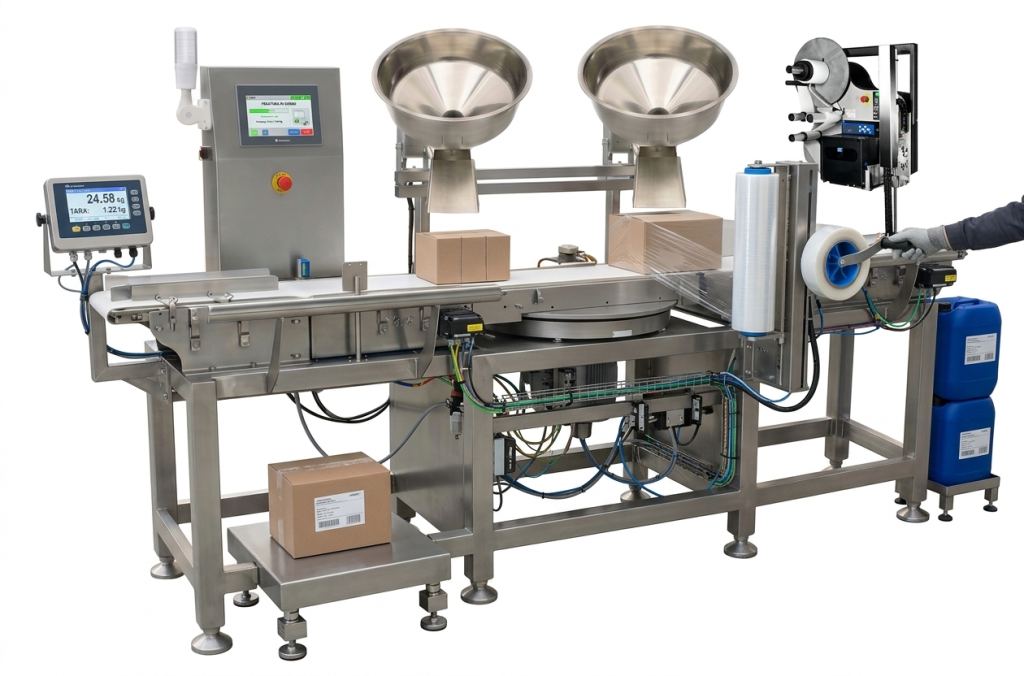
A modern semi-automatic wrapping machine with a rotating table can now directly integrate:
–A weighing system under the platform (no need to move the pallet)
–Two industrial cameras to photograph the finished pallet from two sides
–Mini PC with connectivity software to send weight and photos to the management system (via Ethernet, standard formats such as CSV, SQL, or MQTT)
No more moving the pallet. No more manual transcriptions. No more “I don’t have proof.”
Why This Solution Is Ideal for Automotive Aftermarket Logistics
1. Integrated Weighing with Automatic Data Transmission to the Management System
In the auto parts industry, weight is often the basis for:
Calculating shipping costs
Verifying order completeness (theoretical weight vs. actual weight)
Generating shipping documents (DDT, delivery note)
With the integrated system, the scale is no longer a separate workstation. The weight is read automatically and sent via the network to the management system (WMS, ERP, or TMS). No operator needs to transcribe anything. Zero data entry errors.
2. Mandatory double photography before shipment
Two fixed cameras (with dedicated lenses and lighting) take two photos of the finished pallet—typically front and back, or front and top view.
What is the purpose?
-Proof of integrity: if the pallet arrives damaged, the carrier cannot claim “it was already broken at the time of loading”
-Proof of contents: in case of a dispute over missing goods, the photo proves what was actually there
-Internal audit: it is possible to verify retrospectively whether an operator wrapped the pallet correctly
The photos are saved and linked to the weight and pallet identifier (e.g., waybill number, barcode).
3. Speed Suited to Average Volume
Not everyone needs an automatic line capable of handling 100 pallets per hour. For volumes ranging from a few dozen to about a hundred pallets per day, a high-quality semi-automatic system is the right balance.
An operator can comfortably manage the flow, without stress or bottlenecks, with significantly reduced handling times per pallet compared to separate operations.
4. Quality wrapping
Wrapping quality is critical for pallets of spare parts:
Tires tend to shift if not secured properly
Heavy parts (brake discs) can puncture the film if there isn’t enough tension
Bulky parts (bumpers) require differentiated wrapping
A good semi-automatic wrapper offers motorized pre-stretch (typically up to 200–250%) and film tension control adjustable from the panel. Quick-load reel systems allow for film changes in just a few seconds.
5. Traceability and IT integration without costly custom development
One of the most common concerns is: “Our machine doesn’t communicate with our management system.” A well-designed solution includes:
On-board industrial mini PC
Connector software supporting standard formats (CSV, SQL, MQTT, OPC-UA)
Pre-configured Ethernet connection
No costly software customizations are needed (unless there are very specific requirements). The data (weight, photo path, timestamp) is already output in a format readable by your WMS or ERP.
6. Ease of Use
The control panel, featuring a graphic display with icons and a selection knob, makes the machine intuitive to use even for inexperienced operators. The various wrapping cycles (up to half a dozen programmable settings) can be selected instantly when switching to a different type of load. Training typically takes one day.
| Aspect | Before (separate stations) | After (integrated station) |
| Weight recorded | Separate scale + manual entry | Integrated + automatic transmission |
| Pallet photo | Tablet/smartphone (forgotten photos, low quality) | Fixed cameras + lighting |
| Connection to management system | Manual entry or hand-created .csv files | Ethernet + connector software |
| Time per pallet | 5–8 minutes (including movement) | 2–4 minutes (all within the station) |
| Weight disputes | Difficult to resolve | Accurate and traceable data |
| Damage disputes | “No one knows who caused the damage” | Pre-shipment photographic evidence |
| Operators required | 1–2 (depending on throughput) | Only 1 operator |
For which aftermarket products/sectors is this recommended?
This approach—using a wrapping machine, weighing, and photos—is particularly effective for:
-Tires (cars, motorcycles, trucks) — unstable pallets, requiring securing
-Brake discs, drums, springs — heavy parts requiring controlled tension
-Bumpers, hoods, headlights — bulky items, risk of damage during transit
-Mixed pallets of spare parts (multiple orders on the same pallet) — photos are needed to distinguish between batches
-Spare parts distributors shipping to tire shops and repair shops — frequent disputes over weights
It is not, however, suitable for very tall pallets (over approximately 2.2 meters) or extremely unstable loads that require an optional presser (which can still be added).
The Value of Data: From Packaging to Traceability
In the world of logistics, more and more customers are demanding proof that a shipment has been sent correctly. It is no longer enough to say, “The pallet has been shipped.” You must demonstrate:
-How much it weighed (to verify completeness)
-How it was wrapped (to prove it was intact)
-What it contained visually (to identify the cargo)
A system that integrates wrapping, weighing, and photography—and automatically sends this data to the management system—transforms the packaging operation from a cost into an element of traceability and legal protection.
Conclusion
For an automotive parts or tire distribution company that ships several dozen pallets a day, investing in a semi-automatic wrapping machine with integrated weighing and photo capabilities means:
-Reducing end-of-line processing times (no more lines at the scale)
-Eliminating weight transcription errors
-Having photographic evidence to counter disputes from the carrier or the customer
-Integrating data with the management system without costly development
-Protecting the brand from unprovable transport damage
You don’t need an automated line costing hundreds of thousands of euros. With a modest investment and a simple installation (requiring only an electrical outlet and network/WiFi access), you can transform a wrapping station into an end-of-line quality control and traceability center.
And in a world where every unmanaged dispute costs time and reputation, this is no longer just a packaging machine. It’s an insurance policy that pays for itself with the first complaint it prevents.