



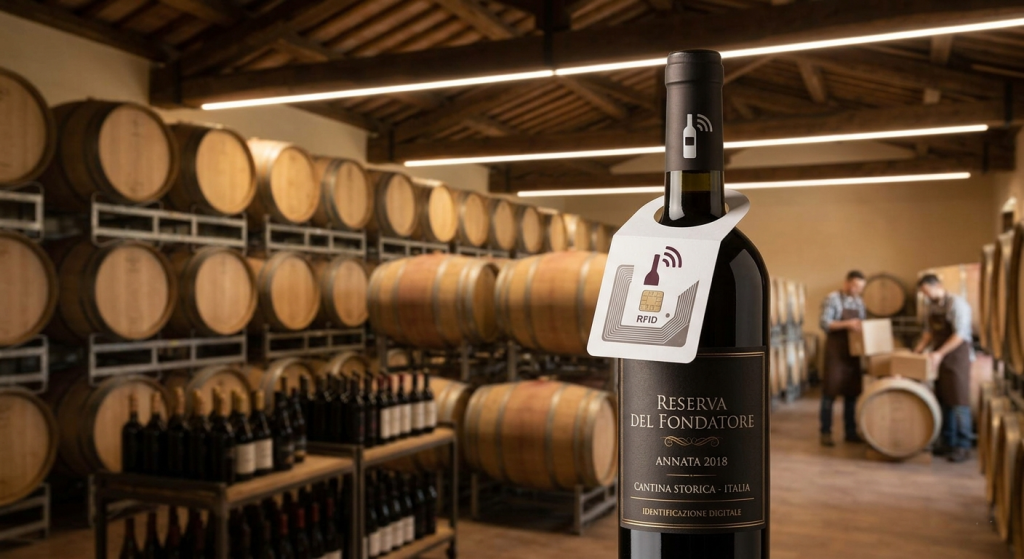
In the modern wine sector, the challenge is no longer just to produce a wine of excellence, but to ensure its authenticity throughout the supply chain and optimize global distribution processes. Recently, the adoption of integrated solutions based on RFID (Radio Frequency Identification) and NFC (Near Field Communication) technologies has marked a turning point for companies handling large production volumes.
We see how the integration of these technologies can solve three critical problems: counterfeiting, the parallel market, and warehouse efficiency.
1. Security and Authenticity at Smartphone’s reach
Brand protection starts with the individual bottle. Applying an NFC Tag directly to the label turns each product into a “speaking” object. Unlike simple QR codes, the NFC tags used are not clonable. The final consumer, simply by placing their smartphone close to the bottle, can check the originality of the product in real time, view technical data sheets and access exclusive content, such as wine club membership or geolocation of the nearest retailer.
2. Total Control of Distribution
One of the biggest risks for successful wineries is the so-called “parallel market”. Thanks to the unique traceability provided by the tags, the company can monitor the path of each individual crate or pallet. Knowing exactly which distributor was assigned a particular batch allows you to instantly identify any violations of commercial agreements, protecting the official partners and the brand’s reputation on international markets.
3. Logistics 4.0: Automation and Efficiency
Technological integration does not stop at product protection, but enters the heart of production processes:
- In-line tracking: Special detection systems installed along the bottling chain are able to read tag data on moving bottles and boxes. This allows you to instantly check production compliance and update stocks in real time.
- Error-free order fulfillment: Picking and shipping operations are speeded up by the use of portable readers. Operators can check the congruence between the order received from the manager and the products actually loaded, drastically reducing the risk of human error.
- Data interconnection: The system dialogues directly with the company management software (ERP), making the winery a true structure compliant with Industry 4.0 paradigms.
Tangible results
Adopting an integrated traceability system brings measurable benefits in a short time:
- Time saving: Automation of inventory and shipment preparation phases.
- Waste reduction: Elimination of logistical inefficiencies and shipping errors.
- Direct marketing: A new communication channel between producer and consumer, active even in the absence of an internet connection for basic authentication functions.
In conclusion, RFID/NFC technology is no longer a luxury for the few, but an indispensable tool for wineries looking to the future, eager to protect their work and offer a transparent and innovative service to their customers around the world.
Key points of innovation:
- Traceability: From single piece to full pallet.
- Anti-counterfeiting: Unclonable NFC technology.
- Automation: Integration with existing management systems.
- Engagement: Direct connection with the end customer.