


In the manufacturing and ceramic sectors, the efficient management of industrial molds represents one of the most critical variables in determining profitability and smooth production. Without precise traceability, companies often face inefficiencies that weigh directly on their balance sheets.
The operational criticalities of traditional management
Before adopting advanced digital solutions, many manufacturing companies face common challenges that limit their competitiveness:
- High maintenance costs: Huge annual expenses that require on-time traceability to be optimized and reduced.
- Inaccurate monitoring: In the absence of real-time data, it is difficult to predict actual die wear, often based on rough estimates.
- Suboptimal maintenance: Interventions performed without a reliable database inevitably lead to production waste and unplanned downtime.
- High search times: In complex warehouses and production areas, locating a specific mold can take a long time, slowing down the start of production.
The technological solution: Traceability and Intelligent Maintenance
The integration of RFID (Radio Frequency Identification) technology allows for the creation of an end-to-end management ecosystem, transforming physical assets into talking digital entities.
The pillars of the solution:
- High-strength RFID tags: Applied to every mold and press, they are designed to withstand strong thermal and mechanical stresses.
- Automatic detection on press: Antennas configured to identify the mounted mould and monitor its activity in real time (stroke or cycle count).
- Precision localization: The use of handheld devices allows you to identify a specific mold from meters away, simplifying inventories and sampling.
- Data centralization platform: Dedicated software associates the unique identifier of the asset with its “Digital Twin” (digital twin), centralizing any useful information.
Key features for the smart factory
Digitalization radically transforms daily operations through advanced features:
- Exact knowledge of work cycles: Point-by-point monitoring of the number of strokes made by each mold, eliminating any margin for error.
- Predictive maintenance: The system automates checks and plans interventions only when truly necessary, based on the actual state of wear.
- Item Finder: An active guide that leads the operator towards the desired asset, eliminating downtime.
- Analysis Dashboard: Production data visualization and exportable reporting for in-depth line performance analysis.
Measurable results
The shift to intelligent mold management ensures tangible and measurable benefits in a short time:
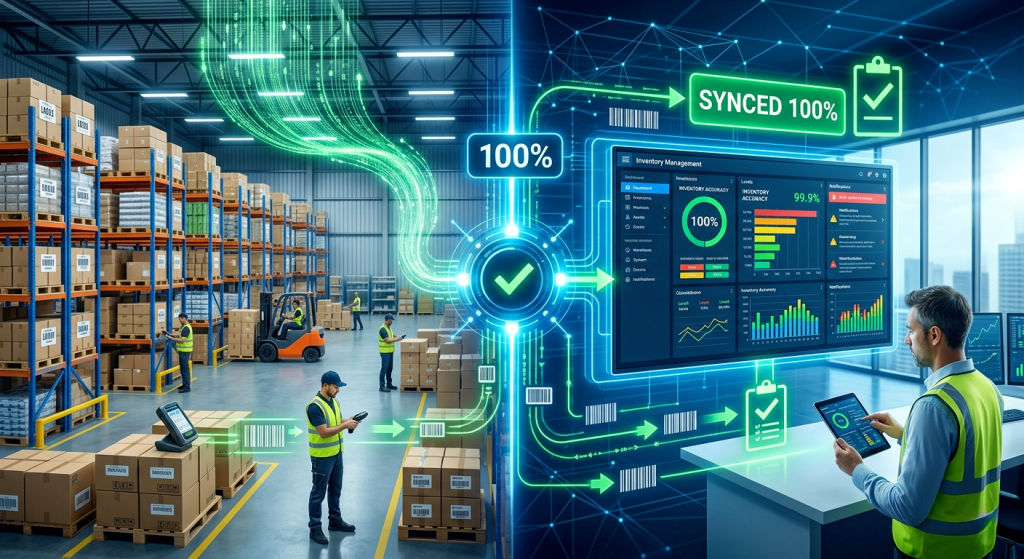
- Data accuracy greater than 99%: Total correspondence between physical warehouse and information system, eliminating manual errors.
- Reduction of warehouse management costs (-30%): Optimization of loading and unloading processes and storage.
- Maintenance optimization: The transition to predictive models extends the useful life of molds and reduces unnecessary interventions.
- Eliminating machine stops: Sudden stops are almost reset thanks to real-world programming.
- Seamless Integration: The system integrates seamlessly with management software (ERP) already present in the company, ensuring business continuity.
In conclusion, advanced traceability is not just a technological upgrade, but a strategic choice that allows for a rapid return on investment (ROI), transforming a cost center into a driver of efficiency and quality.