



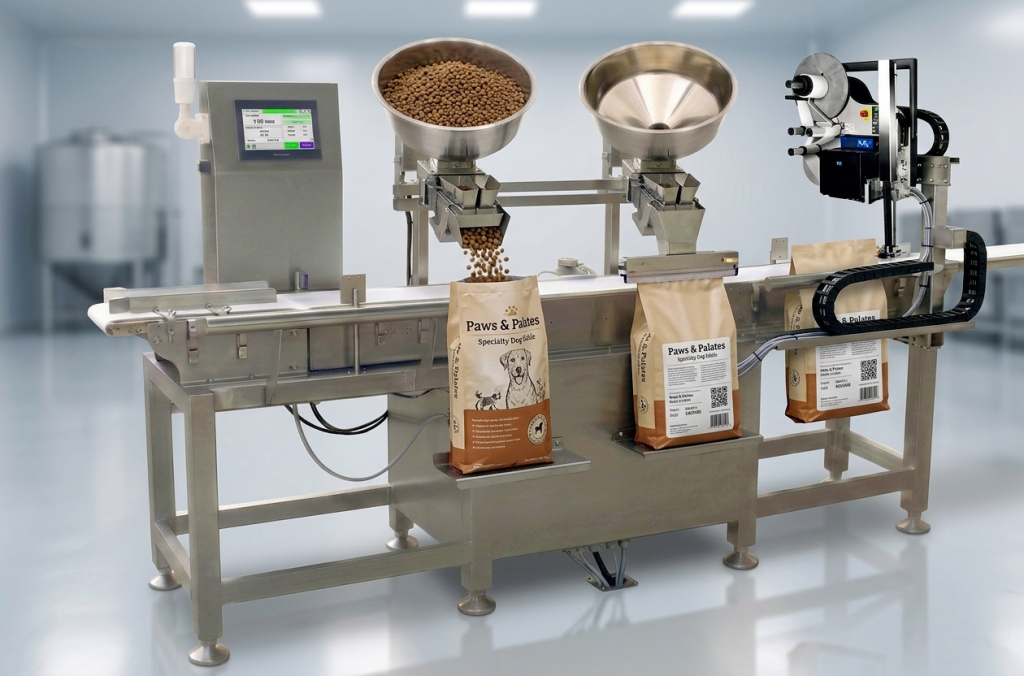
In the world of producing high-end pet feed (pet food specialty) and technical animal feed, packaging has never been “just” an envelope or a box. It is the point where:
-The freshness and preservation of the product are guaranteed (lipids, flavourings, vitamins)
-Food safety meets mandatory traceability (feed = EC Regulation 183/2005 and later)
-Brand communication (premium, natural, organic) becomes tangible
-The sustainability of packaging is now a purchasing criterion for conscious owners
Yet, many pet food specialty producers (not mass market giants, but small-to-medium-sized companies with high-value-added products) face daily challenges that seem minor but cost expensive:
-Sachets that deflate after a few weeks (loss of protective gas)
-Seals that give way when in contact with the fats of the kibble
-Complex batch traceability when packaging different recipes on the same line
-Frequent format changes (200g, 500g, 2kg, 5kg) that stop production
-Excessive plastic in packaging, increasingly criticized by specialized distributors
The solution is not “buy a bigger poucher”. Often, the real breakthrough comes from an integrated packaging system that combines –in a single flow – packaging, quality control, traceability, and format flexibility.
The packaging paradox in pet food specialty
Imagine a typical manufacturer of kibble for small dogs, neutered cats, or single-serving wet treats. There are many formats:
-200g, 500g, 2kg zip-lock bags (open and resealed by customer)
-50g sachet for moist snacks
-Valve bags for products that need gas venting (but not in pet food, oxidation is avoided)
-Multipack packs (box with 12 sachets)
Today, many companies handle packaging like this:
-A machine forms/fills/seals the envelope (often with basic performance)
-An operator takes a sample and tests the seal (manually, a few pieces)
-A second machine applies the lot and expiration label
-A metal detector (mandatory for feed) is often at the bottom of the line, separate
Someone weighs every 10 packs and transcribes data on paper or in a management
Result:
-Defects that escape (incomplete seals that reach the customer, with rancid product)
-Ballerina traceability (if a recall is triggered, it is not known for certain which lots are affected)
-Long format changeover times, which eat up the profitability of small batches
-Sample quality control, not 100% of parts
The crux of the matter is that packaging, quality control, traceability and metal detection are four separate operations. As long as they remain separate, the risk of non-compliance and the slowness of the format changeover multiply.
The Solution: An Integrated Ecosystem for Pet Food Specialty
Z Automation’s packaging machines and systems offer a different approach, specifically designed for the small to medium volumes and variety of formats typical of pet food specialty. They integrate:
-High-speed pouch formers with zip-lock pouches or special seals
-Automatic quality control (sealing integrity, weight, label presence)
-Lot traceability with direct printing on the envelope or label
-Integration with metal detectors (or other control systems)
-Autonomous waste systems for defective
-Management software for monitoring and integration with management
And the most interesting solution for this sector is the “all-in-one” approach similar to GreenPack RFID 4.0 (described on the website): a compact system that combines multiple critical functions in a single machine, reducing space and intermediate steps.
Why an integrated system is ideal for pet food specialty
- Reliable sealing even with fatty products
Wet kibble and snacks contain fats that can migrate to the sealing area, compromising the seal. A good integrated bagger offers:
-Sealing temperature control to fit different materials
-Cold welding or with paired bars for greased surfaces
-Automatic leak check immediately after sealing
No more sachets that open in the store or at the customer’s home.
- 100% quality control (not sample)
In pet food specialty, every defective package that reaches the customer is:
-Image damage (premium brand is associated with “poor quality”)
-A health risk (altered animal food)
-A return and claim handling cost
The integrated system automatically verifies each individual package:
-Correct sealing (thermal or pressure)
-Content weight (with in-line load cell)
-Presence and legibility of label or direct printing
-Absence of metals (if integrated with metal detectors)
Non-compliant products are discarded on their own immediately after leaving the machine, without human intervention. Zero defects that reach the customer.
- Error-free batch and expiration traceability
In the feed sector, traceability is required by law (Regulation (EC) No 183/2005). Each package must indelibly state:
-Batch number (linked to recipe and production date)
-Expiry date (often 12-18 months)
-Establishment identifier
The integrated system can print and verify this data automatically, either directly on the envelope (with thermal transfer) or on a label applied in line. In the event of a recall, you know exactly which packages were produced in that batch.
Optionally, for high-value products or selective distribution channels, an RFID tag can be added for traceability throughout the supply chain (useful for combating parallel selling or counterfeiting).
- Quick format change (essential for the variety of recipes)
A pet food specialty manufacturer can package today:
-200g Zip-Lock Bags for Sterilized Cats
-2kg bags for small dogs
-50g single-serving wet snack bags
With Z Automation machines, format switching occurs via:
-Calling up a program on the PLC (saves sealing parameters, target weight, speed)
-Quick-change mechanical trainers (a few minutes)
-Adjustable guides and tapes without tools
You don’t need hours of downtime or specialized toolmakers. For those producing small batches (even a few hundred pieces per reference), this flexibility is vital to profitability.
- Sustainability of packaging with green materials
Pet food specialty consumers are often very concerned about sustainability. Multilayer plastic (PET/PE) pouches are increasingly criticized. The eco-friendly packaging solutions offered by Z Automation (e.g. GreenPack) allow you to use:
-Paper-based materials with natural barrier
-Compostable biopolymers (for single-serving snacks)
-Recyclable single-material films (instead of difficult-to-recycle multilayer films)
-Commercial advantage: Being able to write “100% recyclable bag” or “home compostable” on the packaging makes a difference in premium placement.
- Integration with production management (ERP/MES)
In pet food, batches are often linked to complex recipes (different raw materials, vitamins, additives). Traceability starts upstream, but closes downstream with packaging. An integrated system that automatically sends to management:
-How many packs produced for each batch
-How much waste (and the reason: weight, sealing, metal)
-The sample photos (optional)
-The production data (speed, stop, efficiency)
makes batch closure automatic and without transcription errors. The connector software supports standard formats (CSV, SQL, MQTT, OPC-UA) and interfaces with most industry ERPs.
Summary table: before and after
| Aspect | First (separate stations) | After (Z Automation integrated system) |
| Sealing | Basic machine, no verification | 100% automatic control |
| Defect control | Spot visual inspection (failible) | Sensors + autonomous scrap (100% of the pieces) |
| Traceability | Separate label maker or offline printing | Online data printing and verification |
| Format change | Hours of detention and toolmakers | Minutes with callable programs |
| Space in the establishment | 3-4 cars in a row | 1-2 machines (50% savings) |
| IT Integration | Handmade manual or.csv files | Automatic (Ethernet, standard formats) |
| Sustainability | Difficult with traditional machines | Green materials and low impact films |
For which products/sectors pet food/animals is indicated?
This approach is particularly effective for:
-Small dog and cat kibble (200g to 5kg)
-Single-dose wet sachet snacks (for dogs, cats, ferrets)
-Dehydrated reptile foods (insects, freeze-dried vegetables)
-Farmed fish feed (pellets, flakes) in packs of 50g to 2kg
-Veterinary supplements in powder or lozenges (blister or sachet formats)
-Dietary products for animals (veterinary prescription)
However, it is not indicated for rigid packages (traditional wet cans) or for liquid products (animal drinks) that require different lines.
The benefits in a nutshell for a pet food specialty manufacturer
-Zero output defects = fewer complaints, more customer loyalty
-Quick format change = profitable even for small batches (essential for niche manufacturers)
-Certain traceability in case of recall produced (legal obligation)
-Communicable sustainability (competitive advantage in specialty channels)
-Space saved in plant (one system instead of three/four)
-Automatic data to management, no manual transcriptions
-Metal detector integration (required for feed) without having to buy and wire separate equipment
Conclusion
In the pet food specialty and technical animal feed sector, packaging is no longer a marginal end-of-line operation. It’s the moment of truth: the moment when the product becomes safe, traceable, sustainable, and ready for the end customer.
Relying on a supplier of integrated packaging machines and systems — like Z Automation, with their experience of over 15 years and modular solutions — means transforming bottleneck packaging to competitive advantage.
In a market where every envelope opened in the store is a lost customer, where every unmanaged recall costs hundreds of thousands of euros, and where the sustainability of packaging makes a difference on the shelf, this is no longer just a technical choice. It is a choice of survival and differentiation.