


In the world of professional-use detergents and sanitizers (think industrial laundries, cleaning companies, hospitals, nursing homes, cafeterias, and machine shops), packaging has never been a mere detail. It is the point where:
Chemical safety meets mechanical strength
The precise dose must reach the end user intact
Batch traceability becomes mandatory for regulatory compliance
Sustainability is no longer an option but a purchasing requirement
Yet, many manufacturers of professional cleaning chemicals face daily challenges that seem minor but come at a high cost:
Packages that leak during transport (posing risks to other products and the brand’s image)
Labels that get damaged upon contact with moisture or the products themselves
Slow packaging times and end-of-line bottlenecks
Weak traceability in the event of a product recall
Excessive plastic in primary and secondary packaging, increasingly frowned upon by B2B customers
The solution is not simply “buying a faster bagging machine.” Often, the real breakthrough comes from an integrated packaging system that combines—in a single workflow—primary packaging (pouches/sachets), quality control, traceability, and sustainability.
The Paradox of Packaging in Professional Cleaning
Imagine a typical manufacturer of concentrated detergents for industrial laundries or dishwasher tablets for professional use. The formats vary:
-Single-use sachets (e.g., 50 ml for one wash cycle)
-Refill sachets (e.g., 5 liters of concentrated sanitizer)
-Blister-pack tablets (for dishwashers)
-Multipacks (boxes of 10, 20, 100 pieces)
Today, many companies handle packaging this way:
-A machine forms, fills, and seals the pouch or sachet
-An operator takes a sample and visually checks the seal (a fallible process)
-A second machine (or operator) applies a label with the batch number and expiration date
-A third check, often manual, weighs the package or verifies there are no leaks
-Someone takes a photo (maybe) and transcribes the data onto a sheet of paper or into a management system
Result:
-Three or four steps where one would suffice
-Defects that slip through (unsealed pouches reaching the customer)
-Incomplete traceability (if a batch is missed, it’s difficult to trace all packages)
-Time and costs that are double or triple those of an integrated system
The crux of the matter is that packaging (pouch/sachet), quality control, and traceability are three separate operations. As long as they remain separate, errors multiply and productivity suffers.
The Solution: An Integrated Ecosystem for Professional Cleaning
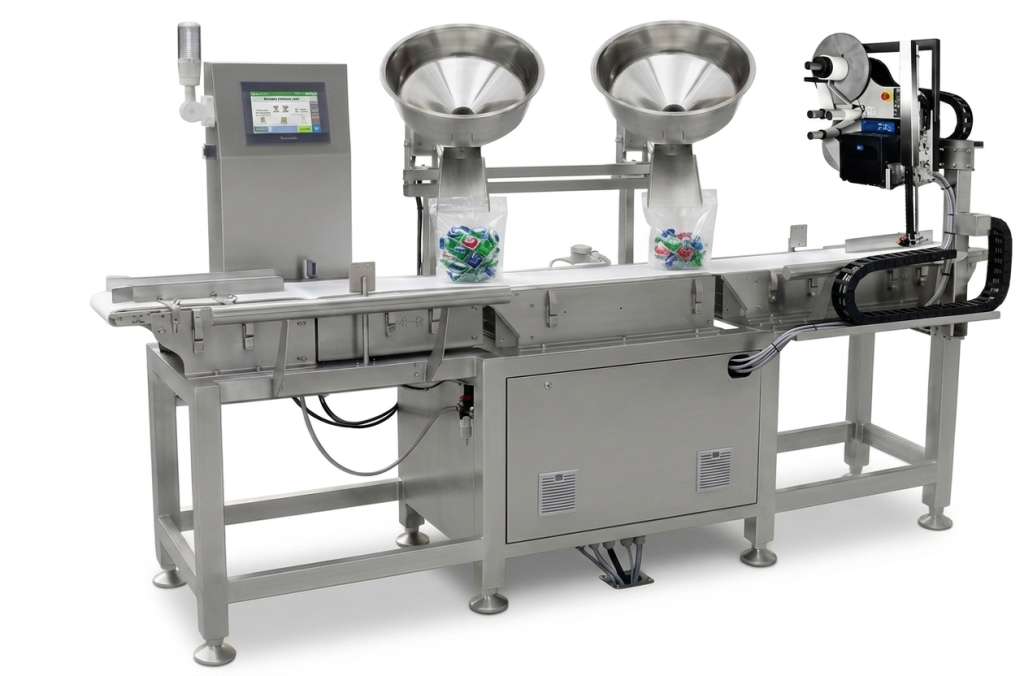
Z Automation’s packaging machines and systems offer a different approach: not individual machines, but an ecosystem designed for the medium-volume production and variety of formats typical of the cleaning industry. They include:
-High-speed bagging machines (including for single-dose and sachet formats)
-Automatic quality control (seal integrity, weight, label presence)
-Optional RFID traceability or serial batch printing
-Handling systems and autonomous rejection of defective items
-Management software for monitoring and integration with the ERP system
And the most compelling solution for this sector is GreenPack RFID 4.0 (or similar solutions): a compact system that combines the three critical functions for professional cleaning into a single machine.
Why an integrated system is ideal for professional cleaning and sanitizing products
1. Eco-friendly packaging (less plastic, less energy)
Professional cleaning products are under significant pressure to reduce plastic use. B2B customers (hotels, hospitals, laundries) are demanding low-impact packaging. GreenPack 4.0 solutions use innovative materials based on paper or biopolymers, which can be sealed cold or with very low heat.
Concrete benefits for professional cleaning:
-70% less energy compared to traditional heat sealers (important for high-volume users)
-No oven (less space required, less maintenance)
-Eco-friendly packaging to highlight to end customers (marketing advantage)
-Pre-stretched films that are thinner yet resistant to liquid leakage
2. Integrated quality control (not a separate process)
In the cleaning industry, a bag that leaks during transport can ruin the entire box, lead to complaints, and damage the brand’s image. The system automatically checks:
-Proper sealing (thermal or pressure integrity)
-Presence of label (position, legibility even on damp surfaces)
-Content weight (when combined with upstream weighing machines)
Non-compliant products are automatically rejected immediately after bagging, without human intervention. Zero defective pouches reach the customer.
3. Error-free batch and expiration date tracking
In the professional cleaning chemicals industry, traceability is not optional (REACH, CLP regulations, etc.). Each package must bear the following information in indelible ink:
-Batch number
-Manufacturing/expiration date
-Hazard symbols (if applicable)
The integrated system can automatically print and verify this data directly on the label or pouch. Optionally, for high-value products or those at risk of counterfeiting, an RFID tag can be added to enable traceability throughout the supply chain.
4. Rapid format change (essential for product variety)
A manufacturer of professional cleaning products can currently package:
-30 ml single-dose sachets for dishwashers
-5-liter sachets of concentrated sanitizer
-20-count blister packs of tablets
With Z Automation machines, format changeover is achieved by calling up a program on the PLC and making quick mechanical adjustments. No machine downtime or specialized toolmakers are required.
5. Sustainability as a marketing tool
Sustainability is no longer just “doing the right thing.” It is a competitive advantage when dealing with increasingly discerning B2B customers. Being able to state in sales proposals: “Our detergent is packaged in primary packaging made from biodegradable material, with a 70% energy savings compared to industry standards” makes all the difference in tenders for hospitals, hotels, and large cleaning chains.
6. Integration with your management system without costly development
A common concern is: “This machine will never communicate with our ERP.” A well-designed solution already includes:
-On-board industrial mini PC
-Connector software that supports standard formats (CSV, SQL, MQTT, OPC-UA)
-Pre-configured Ethernet connection
Production data (good parts, rejected parts, batches, sample photos) is already output in a format readable by your WMS or ERP. No costly software customizations are needed (unless there are very specific requirements).
Summary Table: Before and After
| Aspect | Before (separate stations) | After (Z Automation integrated system) |
| Bagging | Single machine | Bagging machine + in-line quality control |
| Defect detection | Random visual inspection (fallible) | Automatic sensors + 100% autonomous rejection |
| Traceability | Separate or manual labeling machine | printing and data verification (optional RFID) |
| Sustainability | Difficult with traditional heat-sealing machines | GreenPack: eco-friendly materials, 70% less energy |
| Format changeover | Downtime and tooling technicians | Minutes with callable programs |
| Factory floor space | 3 machines in a row | 1 single compact machine |
| IT integration | Manual or hand-created .csv files | Automatic (Ethernet, standard formats) |
For which cleaning products/sectors is this recommended?
This approach is particularly effective for:
-Concentrated detergents for industrial laundries (in single-use pouches or sachets)
-Sanitizers and disinfectants for healthcare settings (strict traceability)
-Tablets for professional dishwashers (in blister packs or pouches)
-Degreasers and paint strippers for mechanical workshops (chemical resistance)
-Liquid soaps for bulk refills (1L to 20L sizes)
-Chemicals for swimming pools and spas (chlorine, pH, etc.)
It is not, however, suitable for rigid packaging (glass bottles, bottles with caps) or for food products (where specific certifications are required, which Z Automation can provide upon request, but are not the focus of this article).
Key Benefits for a Professional Cleaning Products Manufacturer
-Fewer defects = fewer complaints, fewer returns, greater customer satisfaction
-Faster production with the same number of operators (or fewer operators for the same volume)
-Sustainability to highlight to B2B customers (competitive advantage)
-Reliable traceability in the event of a product recall
-Space saved in the factory (one machine instead of three)
-Automatic data transfer to the management system, no manual data entry
Conclusion
In the professional hygiene and cleaning products sector, packaging is no longer a minor end-of-line operation. It is the moment of truth: the moment when the product becomes safe, traceable, eco-friendly, and ready for the customer.
Relying on a supplier of integrated packaging machines and systems—such as Z Automation, with over 15 years of experience and solutions like GreenPack RFID 4.0—means transforming packaging from a bottleneck into a competitive advantage.
Faster, greener, safer. And with a single supplier, a single software solution, and a single point of responsibility. In a market where every complaint avoided and every gram of plastic saved counts, this is no longer just a technical choice. It’s a business choice.