


In today’s manufacturing landscape, filling liquids is not just a matter of “pouring” a product into a container. Especially in sectors such as industrial chemicals, lubricants, industrial cleaning agents, and process fluids, this stage is critical to the quality, safety, and profitability of the entire production process.
However, many companies still face daily challenges: inaccurate dosing, slow semi-automatic lines, traceability issues, and product waste. The solution isn’t necessarily a custom-built mega-line, but rather an integrated, flexible, and intelligent filling system like those offered by Z Automation.
Let’s look at the concrete benefits of relying on a modular filling machine for non-food liquids.
The Hidden Problem in Traditional Processes
In many facilities, the filling of technical liquids (solvents, oils, paints, additives) is still done using manual scales or simple filling machines, where the operator adjusts the flow, checks the weight, prints a label separately, and applies it by hand.
Typical results:
-Waste or underweight due to late or early flow stoppages
-End-of-line bottlenecks
-Labeling errors (wrong weight, incorrect batch)
-Poor traceability in the event of inspections or recalls
The core issue is that weighing and labeling remain two disconnected operations. And as long as they remain separate, errors multiply and productivity suffers.
The solution: a single machine for filling, weighing, and labeling
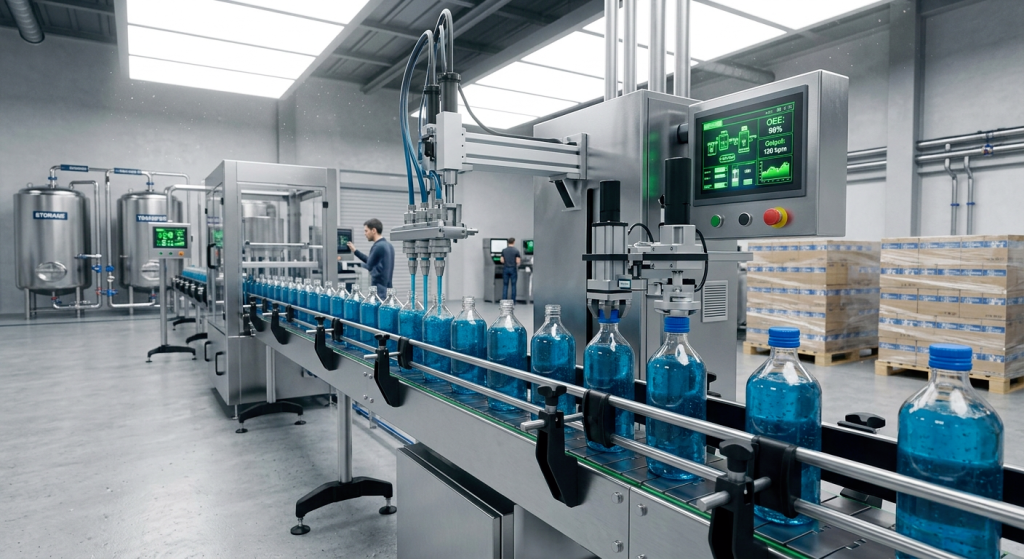
Z Automation’s filling machines and systems overcome this limitation by integrating the three key stages into a single system:
–Controlled liquid feeding (via gravity, pump, or pressure systems, depending on viscosity)
–Real-time weighing with precision load cells (up to 0.01% of the reading)
–Automatic Print & Apply labeling immediately after weighing, without intermediate transfers
The entire process is controlled by a single industrial PLC. The operator sets the target weight on the touch screen, and the machine autonomously manages filling, stopping when the weight is reached, and printing/applying the label with the correct data (weight, date, lot, barcode).
Specific Benefits for the Industrial Fluids Sector
1. Precise Dosing with No Waste
With liquids, even a few grams of waste per package—across thousands of units per day—can add up to significant losses. Load cells ensure a level of accuracy that time- or volume-based filling cannot match, especially with fluids whose density changes with temperature.
2. Mandatory traceability—but without human error
In sectors such as lubricants, chemical additives, or technical detergents, customers and regulations require labels with the batch number and exact weight. With the integrated system, the weight data is automatically sent to the printer. No more manual records, no more pre-printed labels ending up on the wrong container.
3. Productivity Doubled
With two independent weighing stations and a conveyor belt, a single operator can handle volumes that previously required two or three people. While one station fills, the other weighs, and the conveyor belt moves the packaged product away.
4. Flexibility for Different Liquids and Formats
The same machine, with minimal modifications to the feeding unit, can handle:
Free-flowing liquids (process water, solvents, industrial oil, lubricants)
Thick liquids or pastes (paints, resins, adhesives, technical shampoos, abrasive pastes)
Simply change the container format (e.g., from a 1-liter jar to a 20-liter bucket) and the machine adapts without complex mechanical modifications.
5. Scalability without replacing the machine
You can start with 2 weighing/filling stations and expand up to 4, adding modules as volume increases. The PLC and software are already configured. No need to “throw everything out and start over.”
Why choose an integrated system instead of separate solutions?
Aspect Separate operations (manual weighing + labeling) Z Automation System
Accuracy Depends on the operator Load cell 0.01%
Speed Slow, two steps Continuous, single cycle
Labeling errors Frequent (handwritten or off-line printed weight) None (data transmitted automatically)
Traceability Limited Audit trail for each cycle
Why choose an integrated system instead of separate solutions?
| Aspect | Separate operations (manual weighing + labeling) | Z Automation System |
| Accuracy | Depends on the operator | Load cell 0.01% |
| Speed | Slow, two steps | Continuous, single cycle |
| Labeling errors | Frequent (handwritten or off-line printed weight) | None (data transmitted automatically) |
| Traceability | Limited | Audit trail for each cycle |
| Operators required | 2-3 |
Examples of Applications in Industrial Liquids
Numerous companies that manufacture or package:
-Lubricants for machine tools
-Solvents and paint strippers for the metalworking industry
-Technical detergents for plant cleaning
-Chemical additives for water treatment or paints
-Single-component resins and adhesives
have resolved their end-of-line bottlenecks with this approach. There is no need for a custom line costing hundreds of thousands of euros: a modular, integrated machine eliminates intermediate manual steps, reduces waste, and frees up human resources for value-added activities.
Conclusion
Filling industrial liquids doesn’t have to be a trade-off between speed and accuracy. With an integrated automated system like those from Z Automation, you can have both, while reducing waste and improving traceability.
If your packaging line still uses a separate labeler or manual weighing, you’re likely losing time and product every day. Automation isn’t just about replacing the operator; it’s about connecting operations that should never have been separated in the first place.