


In the world of manufacturing tools and equipment for crafts and industry (think keys, drill bits, saw blades, cutters, hammers, shears), marking has never been “just” an engraved name. It is the point where:
-The identity of the producer becomes recognizable and not falsifiable
-The batch number allows you to track the tool in case of production defects
-Technical specifications (diameter, length, hardness, torque) are declared permanently
-Guarantee and responsibility pass through an indelible sign
Yet, many tool manufacturers still face challenges on a daily basis that seem minor but have serious consequences:
–Brands that erase after a few months of use (wear, rust, washing)
–Adhesive labels that come off in the workshop (oil, heat, abrasion)
–Mechanical moulding deforming the tool (especially if small)
–Ink that becomes illegible upon contact with solvents or greases
–Counterfeiting that is difficult to counter with common marking technologies
The solution is not “use a stronger adhesive”. In the tool industry, the real breakthrough comes from an automated laser marking system that produces a permanent, legible, high-resolution, contactless and non-contact mark
The problem that almost everyone underestimates
Imagine a manufacturer of drill bits or circular saw blades. Thousands of pieces per year, of different diameters, lengths and materials (HSS, tungsten carbide, carbon steel). Today, many handle marking like this:
1.The operator takes a batch of tools (e.g. 50 bits)
2.Place them one by one on a small hand press
3.The press hot or cold prints the brand and specifications
4..Or, use an electrochemical pen (etching) to etch
5.Occasionally check that the mark is legible (but by eye, and is often shallow)
Result:
–Low productivity (station-bound operator, piece by piece)
–Shallow brands (wear with use)
–Tool deformation (especially on small or hollow workpieces)
–Marking errors (wrong diameter, unclear logo)
–Costs of consumables (wearing punches, inks, tapes)
The crux of the matter is that every traditional technology has a trade-off: mechanical printing consumes and deforms, the ink doesn’t last, the adhesive peels off. The laser solves all these limitations in a single technology.
The solution: a laser marking system for tools
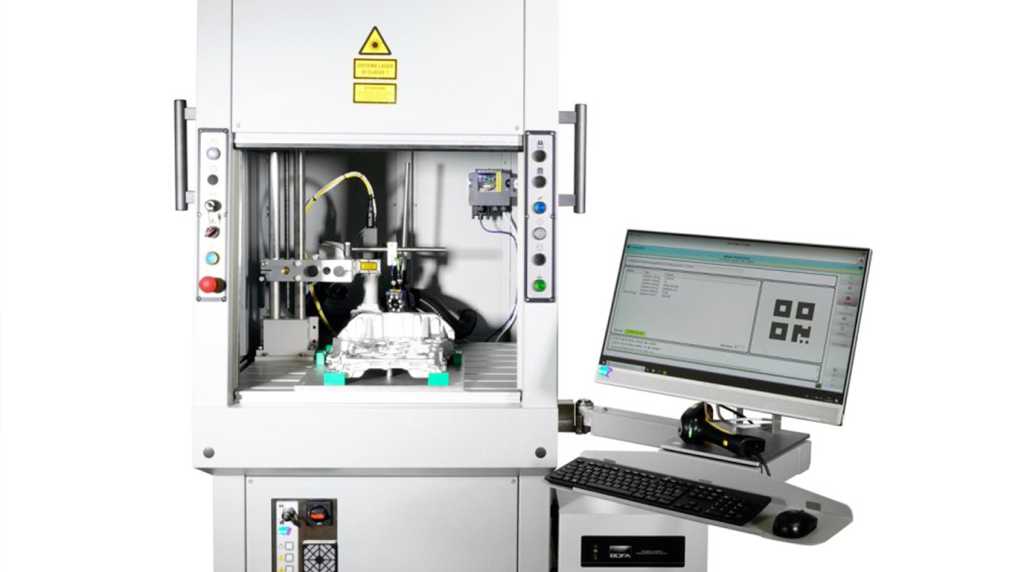
Z Automation’s laser marking machinery and facilities offer a revolutionary approach, designed for metals and hard materials. They integrate:
-Fiber laser source (ideal for metals and technical plastics)
-Handling system (rotor, XY table, conveyor belt)
-Optional vision system (to place the piece exactly where it is needed)
-Management software that generates the brand from production data (lot, specifications, logo)
The goal: permanent, high-resolution, non-contact, non-consumable brand.
Why an integrated laser system is ideal for tools and equipment
- Permanent and all-resistant brand
A tool in the workshop (or on the construction site) is subjected to:
-Abrasion (contact with hard materials, rubbing)
-Oils and fats (lubrication, protection)
-Heat (drilling, cutting, grinding)
-Solvents and detergents (cleaning)
An ink or sticker mark does not survive. A laser mark, on the other hand, etches the material (or permanently changes its color). It is not deleted. It doesn’t come off. It doesn’t fade.
Advantage for the manufacturer: the customer always recognizes the brand, even after years of heavy use.
- No deformation of the part (contactless marking)
Mechanical stamping (punching) can deform thin or hollow tools (e.g. small diameter drill bits, thin blades). The punch impact can:
-Change tip geometry (loss of concentricity)
-Induce internal stresses (risk of rupture)
-Making the piece out of specification
The laser does not touch the piece. The beam acts at a distance, without mechanical force. No deformation, no residual stress. The tool comes out of the marking identical to how it entered, but with a permanent mark.
- High resolution: logo, text, even very small codes
Marking space is often limited on tools. A 3mm diameter drill bit has very little surface area. A hacksaw blade is narrow and long.
The laser allows you to engrave:
-Logos and brands with very fine details (even complex designs)
-Very small serial numbers (e.g. 1mm tall characters)
-Data Matrix (QR-like) codes that contain a lot of information in a small space
-Technical text (diameter, length, hardness, max speed)
The engraving quality is constant and repeatable, it does not depend on the skill of the operator.
- Serial traceability without errors
For tool manufacturers (especially for the professional industry), traceability is increasingly required:
-Batch number to trace back to date, raw material, production parameters
-Progressive number on each piece for unique traceability
With a laser system integrated to the MES/ERP, each piece upon passage receives its own unique serial code, automatically generated by the system
- Zero consumables: savings and sustainability
Traditional technologies have hidden costs:
-Molding: punches that wear out (every x thousands of pieces need to be replaced and realigned)
-Electrochemistry: inks, pastes, transfer paper
-Adhesive labels: consumable, time to apply them
The laser has no consumables. The only cost is electricity (very low) and any maintenance
- Flexibility: same laser for a thousand different tools
A tool manufacturer can have a catalog of hundreds of references: bits, blades, cutters, wrenches, inserts. Each reference has a different brand and specifications.
With the laser, the format change is immediate:
-The marking program is called (piece position, power, speed, text content)
-Place the piece (manually or with a gripping system)
-The cycle starts
The same laser goes from marking a 2 mm tip to a 200 mm blade in seconds. No tool changes, no stops to reload the punches.
- Countering counterfeiting
Branded tools are often the target of counterfeiting. A false mark, printed in ink or roughly engraved, deceives the inexperienced buyer.
The laser allows you to create brands that are difficult to reproduce with artisanal technologies:
-Data Matrix Codes with Micro-Details
-Logos with textures and gradients (e.g. grey effect)
-Marking on difficult surfaces (curves, recesses)
The forger should invest in a professional laser (high cost) and know exactly the parameters. The barrier to entry is high.
Summary table: technologies compared
| Aspect | Mechanical Molding | Electrochemistry/ Labels | Laser marking Z Automation |
| Brand permanence | Good (but wears out) | Poor (deletes) | Excellent (indelible) |
| Deformation of the piece | Possible (especially on small pieces) | Absent | Absent (contactless) |
| Consumable | Punches (wear and tear) | Inks, pastes, adhesives | Zero |
| Resolution/ precision | Discrete (limited) | Good | Very high |
| Speed (for the same volume) | Low (operator per piece) | Variable | High (automatable) |
| Serial traceability | Possible but slow | Possible with labels | Automatic and integrated |
| Counterfeiting | Bass | Bass | High (complex codes) |
| Format change | Requires punch change | Medium (new stencil/tape) | Instant (software) |
For what tools and equipment is it indicated?
This approach is particularly effective for:
–Hand tools: wrenches (fixed, Allen, tube), pliers, hammers, shears, pincers
–Power tools: metal parts of drills, milling machines, screwdrivers, saws
–Cutting tools: drill bits (HSS, carbide), saw blades (ribbons, circular), cutters, taps, dies
–Turning inserts: carbide, ceramic, CBN inserts
–Workshop equipment: vises, jigs, fixing plates, gauges
–Fixing components: special screws, nuts, washers (marking for traceability)
However, it is not indicated for tools made of reflective materials (copper, polished brass) without specific treatments (but the fiber laser adjusts the frequency to adapt), nor for very small tools (<1 mm) where even the slightest sign could alter the functionality (but it can be marked on the shank, not on the active part).
The benefits in summary for a tool manufacturer
1.Permanent brand resistant to wear, oil, heat, solvents
2.No deformation of the part (contactless marking)
3.High resolution (brands even on very small surfaces)
4.Zero consumables (goodbye to punches, inks, labels)
5.Automatic traceability (serial numbers from management)
6.Instant format change (total flexibility)
7.Countering counterfeiting (trademarks that are difficult to forge)
8.Professional image (sharp brand, well positioned)
Conclusion
In the tool and equipment manufacturing industry, marking is not an aesthetic detail. It is a functional requirement for brand identification, for production traceability, for warranty management, for user safety.
Relying on a laser marking machine and plant supplier —like Z Automation, with their experience of over 15 years and fiber solutions for metals — means transforming marking from a slow, consumable, and deforming operation to an automatic, rapid, contactless process with no recurring costs.
In a market where every counterfeit tool damages reputation and where batch traceability is increasingly in demand by professional customers, this is no longer a technical choice. It is a choice of positioning and quality.