


In the world of food production and packaging (think sauces, yogurts, biscuits, coffee, cheeses, fresh meats), the label has never been “just” an adhesive sheet. It is the point where:
-Consumer reads ingredients, allergens and expiration
-The dispenser scans the barcode when passing through the checkout
-The law requires mandatory information (EU Regulation 1169/2011)
-The brand communicates its identity and quality
Yet, many small and medium-sized food companies face challenges on a daily basis that seem trivial but cost expensive:
-Labels peeling off on refrigerated counters (humidity, condensation)
-Unreadable barcodes at the supermarket (faded print, incorrect location)
-Slow manual application with air bubbles (amateur look)
-Label errors (wrong expiration date, wrong batch) that force the product to be recalled
-Slow format change when switching between jars
The solution is not to “buy a more expensive label printer.” In food, the real breakthrough comes from an automated labeling system that combines – in a single flow – precise application, readability verification, compliance with hygiene standards, and batch traceability.
The problem that almost everyone underestimates
Imagine a small company that makes artisanal sauces or farm-raised yogurt. There are tens of thousands of jars a year, of different sizes and recipes. Today, many manage labeling like this:
1.An operator prints rolls of labels from a thermal printer
2.Manually detach the label from the matrix
3.Apply the label to the jar, trying to center it
4.Every now and then check that the barcode is readable (but by eye)
5.At the end of the day, mark on a sheet of paper how many jars he has labeled
Result:
-Low productivity (labelling becomes bottleneck)
-Crooked or bubble labels (unprofessional appearance)
-Label errors (especially when changing recipes or batches)
-Fatigue for operators (repetitive movements hundreds of times a day)
-Uncertain traceability (no automatic recording of what has been labelled)
The crux of the matter is that printing, application, verification, and logging are separate operations. And as long as they remain separate, mistakes and downtime multiply.
The solution: a machine that automatically labels
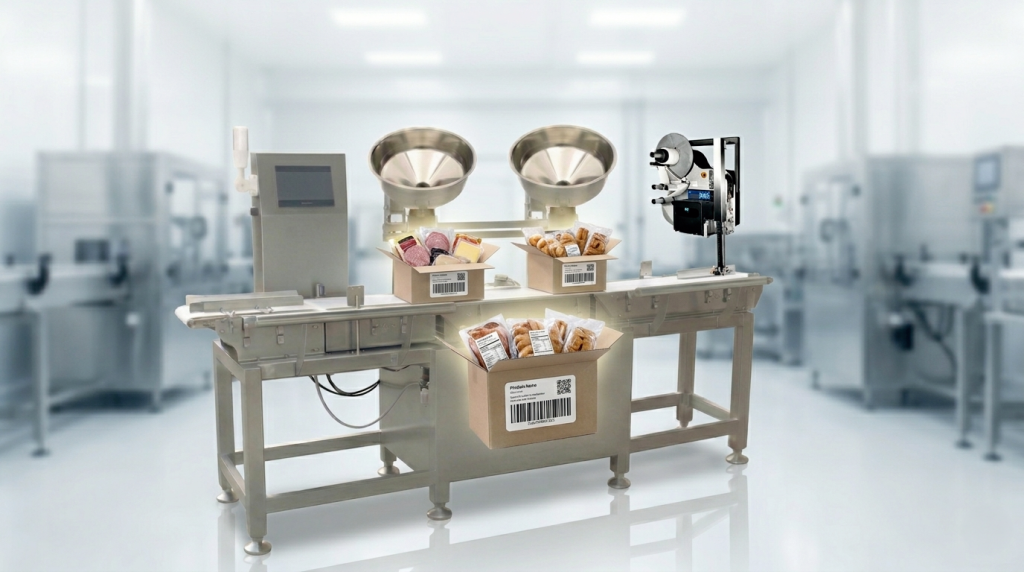
Z Automation’s automated labeling machines and systems solve this problem at its root, integrating into a single system:
-Label Dispenser (from reel)
-Pneumatic or pad applicator (depending on surface)
-Vision system that checks code position and readability
-Management software that records batches, deadlines and quantities
All commanded by an industrial PLC. The operator loads the jars (on tape or manually) and the machine does the rest.
Why an integrated system is ideal for the food sector
- Precise application on surfaces of all types
In food, containers have very different shapes:
-Round jars (yogurt, creams, desserts)
-Jars with reliefs and recesses (underlays, preserves)
-Curved or rectangular bottles (oil, vinegar, soft drinks)
-Low, wide tubs (fresh meat, fish)
-Flexible bags (snacks, coffee, rice)
Z Automation applicators offer specific solutions:
-Controlled breath for delicate surfaces (e.g. fragile yogurt jars)
-Buffer for uneven surfaces where mechanical pressure is needed
-Product rotation systems for cylindrical etiquetting (bottles, jars)
Result: label always centered, no bubbles, well-fitting.
- Moisture, cold and condensation resistant labels
A food product in the refrigerator (supermarket refrigerator) is subjected to:
-Relative humidity close to 100%
-Condensate that forms on the cold surface
-Thermal overhangs (from cold to hot and vice versa during transport)
If the label doesn’t fit, it comes off, curls, or the barcode becomes unreadable. An integrated system can be configured with food-specific materials:
-Polypropylene labels (moisture resistant)
-Permanent adhesives (they do not come off even when cold)
-Heat transfer printing with durable ribbon (code that does not fade)
- Automatic barcode and expiration date verification
In food, an unreadable barcode means:
-The product cannot be scanned at the supermarket (block the checkout, angry customer)
-Distributor rejects supply or applies penalties
Z Automation’s integrated system includes read and verify systems (cited on the site) that:
-They read the barcode they just applied (or printed)
-They verify that it matches the batch and the expected product
-They check the printed expiration date (is it present? is it readable?)
If the label is illegible or incorrect, the system automatically discards the product. Zero anomalies that reach the customer.
- Error-free batch and expiration traceability
By law, every food product must state:
-Lot number (for traceability in case of problem)
-Expiry date (or to be consumed preferably by)
With an automated system, this data can be printed in-line (directly on the label or package), connected to the current production batch. There is no risk of an operator absentmindedly setting the wrong date on the printer. And if the system detects a discordance, it stops or discards.
- Adequate speed at each volume
Whether you produce 500 jars a day or 5,000, there is a suitable solution. Z Automation labelers go:
-From semi-automatic (operator positions product, machine applies) for small volumes
-To the totally automatic in-line (conveyor belt, applicator, verification) for medium and large volumes
The investment adapts to your reality, without oversizing.
- Quick format change (essential for those who produce multiple recipes)
A food company can produce peach yogurt in 125g jars today, coffee yogurt in 500g jars tomorrow, and chocolate puddings in oval tubs the day after tomorrow.
With Z Automation machines, format change takes just a few minutes:
-The product program is called (label location, speed, application type)
-Adjust the guide or tape (simple operation)
-The coil with the labels of the new product is loaded
No hours of downtime between batches.
- Hygiene and cleanliness (fundamental in food)
Z Automation machines for the food sector can be made with:
-Stainless steel for parts that may come into contact with food or the production environment
-Smooth and easy to clean surfaces
-Certifications for use in food environments (on request)
It is not the machine itself that is “food grade” throughout (it is up to the food manufacturer to ensure hygiene), but the design takes into account the need for frequent cleaning.
Summary table: before and after
| Aspect | First (manual labelling) | After (Z Automation system) |
| Speed | Slow (depends on operator) | Constant and predictable |
| Positioning | Variable (crooked, off-center) | Precise and repeatable |
| Air bubbles | Frequent (amateur appearance) | Absent (pressure application) |
| Moisture resistance | Uncertain (generic adhesive) | Certificate (specific materials) |
| Traceability errors | Frequent (batch exchange) | Null (automatic registration) |
| Label errors (lot/expiration) | Possible (distraction) | Impossible (automatic verification) |
| Unreadable barcode | Random check (someone escapes) | 100% verification |
| Format change time | Minutes/hours (manual equipment) | Minutes (preloaded programs) |
| Traceability | Manual recording (errors) | Automatic registration |
For which food products is it indicated?
This approach is particularly effective for:
-Jars of yogurt, desserts, creams (smooth or slightly tapered surfaces)
-Jars of sauces, preserves, honey (glass or plastic, various shapes)
-Bottles of oil, vinegar, soft drinks (cylindrical or front/back labelling)
-Boxes and tins (cookies, chocolates, tuna, legumes)
-Fresh meat and fish tubs (label on film or tub)
-Bags for coffee, tea, snacks, rice (labelling on flexible surface)
However, it is not indicated for frozen products (low-temperature labels require adhesives and special machines, but dedicated versions exist) or for loose fruits and vegetables (where the label goes on the individual fruit, another technology).
The benefits in summary for a food producer
-Professional image (labels always straight, no bubbles)
-Regulatory compliance (lot and expiration always correct)
-Readable barcodes (zero rejections from the distributor)
-Increased productivity (farewell to the manual bottleneck)
-Quick format change (essential for those who produce lots of references)
-Automatic traceability (data ready for possible recalls)
-Operators less stressed (no repetitive movements for hours)
Conclusion
In the food sector, labelling is not a detail. It is the last opportunity to communicate with the consumer, to ensure product safety, to comply with the law.
Relying on a supplier of automated labeling machines and systems — like Z Automation, with over 15 years of experience and solutions for every format and surface — means transforming labeling from a slow, fallible manual operation to an automatic, precise, and verified process.
In a market where every crooked label seems “poorly maintained” and every illegible code stops the supermarket checkout, this is no longer a luxury choice. It’s a choice of professionalism.