



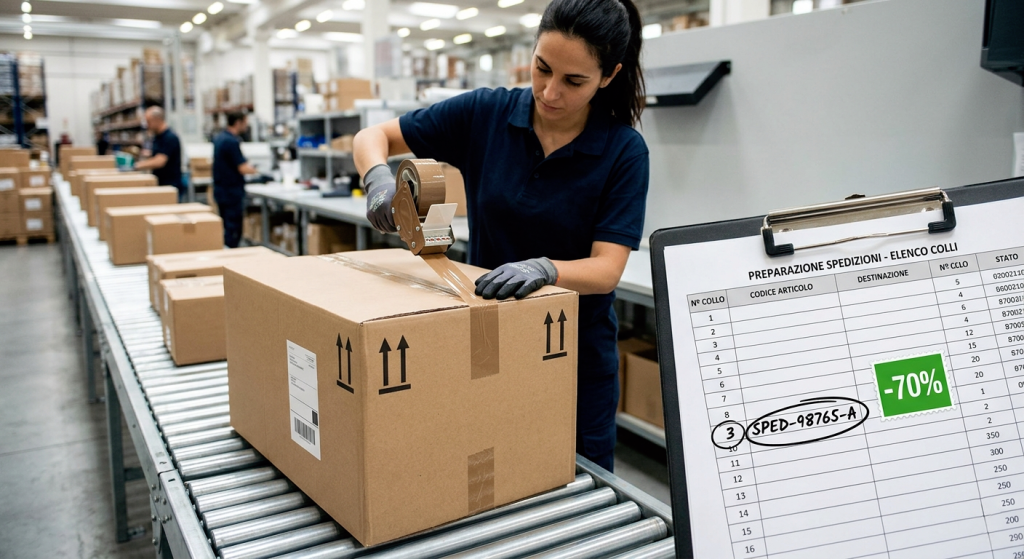
In the modern logistics sector, the preparation of shipments still requires an excessive load of manual tasks. Despite the evolution of management systems, approximately 50% of 3PL operators (third-party logistics) still dedicate valuable hours to manually compiling packing lists.
This process is not only slow, but risky: it often leads to errors on the packages, documentary inconsistencies, and critical slowdowns. As volumes grow, even a small inaccuracy can generate a domino effect of delays, returns, and disputes across the supply chain. For this reason, the automation of shipping documentation has become a strategic priority.
The “Bottle Neck” of the Manual Packing List
The packing list is the heart of the expedition: it must contain precise details on items, quantities and composition of the packages. When this document is created manually or with semi-analog processes, inevitable critical issues arise:
- Excessive expenditure of time: Hours taken away from activities with greater added value.
- Transcription errors: Code and quantity exchanges that affect the reliability of the service.
- Data misalignment: Differences between the actual contents of the packages and what is declared on paper.
- Operational stress: A constant pressure on employees that increases the risk of oversights.
Logistics 4.0: Say Goodbye to Manual Packing List Compilation
In the modern logistics sector, the preparation of shipments still requires an excessive load of manual tasks. Despite the evolution of management systems, approximately 50% of 3PL operators (third-party logistics) still dedicate valuable hours to manually compiling packing lists.
This process is not only slow, but risky: it often leads to errors on the packages, documentary inconsistencies, and critical slowdowns. As volumes grow, even a small inaccuracy can generate a domino effect of delays, returns, and disputes across the supply chain. For this reason, the automation of shipping documentation has become a strategic priority.
Towards Automation: The Digital Packing List
To overcome these obstacles, the most innovative companies are adopting Digital Packing List solutions. These systems use RFID (Radio Frequency Identification) technology to automatically identify products during operational phases, eliminating manual data entry.
How does the automated process work? Tags applied to articles or packages are instantly detected by sensors during handling. The software processes the data in real time and automatically generates the document, including:
- Exact list of items shipped.
- Precise count of quantities.
- Detailed composition of each individual neck.
The result is an instant-ready document that can be integrated into business systems immediately and is free of human error.
Key Features of an Advanced Solution
An effective document automation solution is not an island, but an integrated component of the logistics flow. Its main features include:
- Automatic detection: Creation of necks and quantities based solely on technological reading of tags.
- Flexible templates: Ability to customize document templates to suit different clients’ standards.
- Total Synchronization: Native integration with WMS (Warehouse Management System) and TMS (Transport Management System) systems.
- Monitoring Dashboard: A centralized view that eliminates the need for manual data entry.
Concrete Results: Efficiency and Accuracy
The impact of automation on outbound logistics is immediate and measurable. Companies that digitized this process found:
- 70% reduction in shipment preparation time.
- Drastic reduction of documentary errors.
- Total consistency between physical goods and paper/digital documentation.
- Acceleration of warehouse exit flows.
Conclusion: The Future is Digital
The digital transformation of logistics is not just about robots moving goods, but also about intelligent data management. Automating the production of packing lists means turning a cost and error center into a competitive advantage, making flows faster, more accurate, and more efficient.
It’s time to free staff from repetitive, low-value-added tasks to focus on truly smart logistics.