


Automating the Packaging of Small Technical Components: Why the Integrated Weighing and Labeling Station Changes the Game
In the world of industrial manufacturing, there is a category of products that is often underestimated: small and medium-sized non-metallic or mixed-material components. These include:
-Plastic clips and cable ties
-Spacers and pins made of engineering plastics (nylon, POM, PTFE)
-Small housings or covers for electronic devices
-Connectors, terminals, and terminals (including plastic ones)
-Discrete electronic components (capacitors, small transformers, fuses)
Electronics, electrical engineering, and automotive companies—including Tier 2 suppliers and assembly subcontractors—handle thousands of these parts every day, facing a recurring challenge: the end-of-line bottleneck.
The problem isn’t producing the parts. The problem is counting them, weighing them accurately, placing them in the right container, and applying the correct label—quickly, without errors, and without requiring three operators.
The Hidden Cost of “Manual Packaging”
Many workshops and assembly plants still operate this way today:
-The operator takes an empty bag or box
-Pours the parts in “by eye” or using a measuring cup
-Places everything on a bench scale
-Adds or removes parts multiple times to get closer to the target weight
-Writes down the weight on a sheet of paper (or prints a label from a separate printer)
-Attaches the label by hand
The result is always the same:
-Long processing times
-Stressed operators, tied to their workstations
-Weight errors outside specifications
-Incorrect or illegible labels
-No true traceability
And the real issue? Weighing and labeling are two separate operations. As long as they remain separate, the margin for error is extremely high and productivity remains low
One machine, one operator, one production line
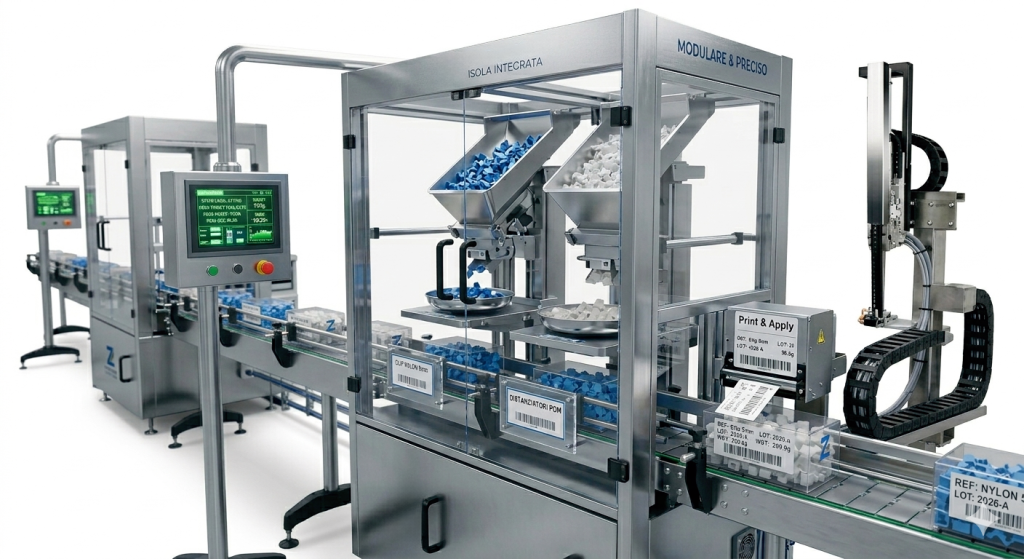
Z Automation’s industrial filling machines and systems solve this problem at its root by integrating the following into a single system:
–Automatic feeding via vibrating hoppers (suitable even for parts with irregular shapes)
–Real-time weighing with precision load cells (accurate to 0.01% of the reading)
–Immediate Print & Apply labeling, with no intermediate steps
All controlled by a single PLC with a touchscreen interface. No more scales, printers, or conveyors from different suppliers. There is just one machine. Everything included.
Why this solution is ideal for small technical components
1. Accurate counting by weight, even with irregularly shaped parts
When components are small but not perfectly uniform (e.g., clips, spacers with holes, asymmetrical connectors), counting them by volume is impossible, and counting them one by one with an optical parts counter is costly. High-resolution weighing becomes the most accurate and fastest method. The load cell stops the hopper exactly at the target weight, regardless of how the parts are oriented.
2. No more labeling errors
The most common error in manual packaging is a label that does not match the actual weight (because it is handwritten, printed before weighing, or applied to the wrong container). In the integrated system, the PLC sends the exact weight it has just detected to the printer. The label is correct by definition.
3. Robust traceability without red tape
For automotive or industrial electronics suppliers, traceability (batch, date, weight, reference) is not optional. The system automatically generates an audit trail for each cycle. In the event of an inspection or recall, you don’t have to rely on hand-signed sheets.
4. Productivity Can Be Doubled Immediately
Even with just one operator, the machine runs continuously: while one hopper is filling a box, the other is already weighing the next one. The conveyor belt carries the filled boxes to the labeling machine without delay. Volumes that previously required two people now require only one.
5. Scalable as your business grows
You can start with 2 weighing/filling stations and expand up to 4 simply by adding modules. The software and central PLC are already set up. Nothing goes to waste; you don’t have to buy everything new.
6. Format and product changeover in one minute
Will the customer request a larger box tomorrow? Or a bag instead of a box? Or a different component (e.g., red clips instead of black, but same weight)? Just place the new container on the platform and select the program from the touchscreen. No equipment changes required.
| Aspect | Before (manual) | After (integrated Z Automation system) |
| Operators per shift | 2-3 | 1 |
| Weight errors | At least 1–2% of packages | <0.01% |
| Incorrect labels | Frequent (reversed, wrong weight) | Zero (automatic data) |
| Traceability | Poor, depends on the operator | Every cycle is recorded |
| Linear speed | Variable, subjective | Constant and predictable |
| Product changeover time | Minutes or hours | Seconds (program) |
Typical Applications
Companies that manufacture or assemble:
-Cable ties and cable clamps for electrical panels
-Nylon spacers for PCBs
-Small transformers for power supplies
-Quick-connect connectors (made of engineering plastics)
-Terminals and cable lugs (including insulated ones)
-Component kits for the industrial aftermarket
all share the same need: to weigh and package small batches or large quantities without errors, with a modest investment and an immediate return in terms of reduced waste and manual labor.
When does it make sense to consider this machine?
It’s a good fit if:
-You package small to medium-sized solid components (not liquids or food powders)
-The item may have an irregular shape but can flow through a vibrating hopper
-The target weight is consistent (e.g., 100g, 500g, 2kg)
-he label must include the exact weight and a barcode
-You currently have one or more people dedicated solely to weighing and labeling
–You have multiple product lines (you frequently change products or box sizes)
In all these cases, integrated automation is not a luxury
Conclusion
Packaging small technical components (plastic, electronic, or mixed) doesn’t have to be a manual process. With an automatic filling machine that weighs and labels products, you can eliminate costly errors and free up human resources for tasks with higher added value.
You don’t need a custom system costing hundreds of thousands of euros. Sometimes all it takes is a modular, integrated system—like those from Z Automation—to transform a packaging department from a bottleneck into a driver of efficiency.